Struggling at Work During Menopause? Why Confidence Dips
Struggling at Work During Menopause? 1 Simple CBT Experiment
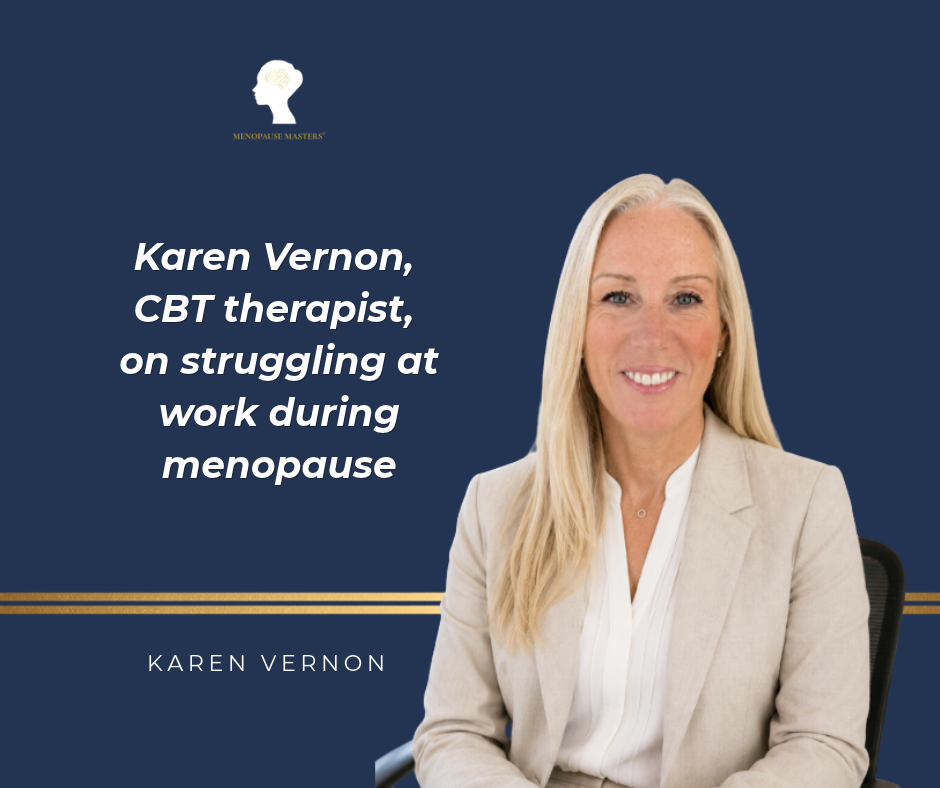
By Karen Vernon, BSc (Hons), RMN, BABCP Accredited Cognitive Behavioural Therapist · 6-minute read
In 30 seconds
- In the Fawcett Society’s 2022 survey, 52% of respondents who had worked during menopause reported losing confidence.
- Symptoms, worry and working conditions can interact. A difficult moment does not define your skills or experience.
- Small, deliberate experiments, rather than big confidence “hacks”, are one of the ways CBT helps you see what you can still do.
You know the answer. You knew it before the meeting started. Then the moment came, the words weren’t quite there, and someone else said it instead.
Afterwards, you go over it again. Not just that meeting, but the email you reread four times before sending, the name that wouldn’t come, the presentation you quietly passed to a colleague. Somewhere along the way a question starts to form: what’s happening to me?
If that’s familiar and you’re struggling at work during menopause or perimenopause, you’re far from alone. And it’s worth saying early: this isn’t another article telling you to believe in yourself.
You’ve probably read a lot about this already
Menopause is everywhere at the moment, and much of what’s out there says similar things: recognise the symptoms, talk to your manager, look after your sleep. All of it is useful. But if you’re still sitting in meetings feeling like a quieter version of yourself, knowing more may not have changed much.
This article looks at something that gets far less attention: how the things we do to protect ourselves at work can, over time, keep confidence low. Understanding that is often where things start to shift.
What the research shows
The Fawcett Society’s 2022 report drew on a survey of 4,014 UK women aged 45–55 who were experiencing, or had previously experienced, perimenopause or menopause. Among those who had worked during menopause, 52% reported lost confidence, 44% said their ability to work had been affected, and 10% said they had left a job because of symptoms.
Common, real, and often invisible to the people around you.
Why it can feel more noticeable at work
Work asks for exactly the things perimenopause can disrupt: quick recall, concentration, staying composed under pressure, thinking on your feet. Three things tend to stack up.
The symptoms themselves. Poor sleep, brain fog and anxiety make it genuinely harder to find a word or hold a thread.
What we tell ourselves about them. A forgotten name becomes “I’m losing my edge.” A blank moment becomes “everyone noticed.” When you’re tired, thoughts like these can feel like facts.
What we do to cope. This is the part most articles skip.
The habits that quietly keep confidence low
When we feel exposed, it’s natural to protect ourselves. In CBT, these protective habits are sometimes called safety behaviours. At work they might look like:
- Over-preparing for every meeting, often late into the evening
- Rereading emails several times before sending
- Staying quiet unless you’re completely sure
- Saying no to the presentation, the stretch project or the promotion
Some checking or avoidance can bring short-term relief while keeping anxiety going. Notes, preparation and agreed workplace adjustments can also be useful supports. What matters is their purpose and effect, not simply whether you rely on them. CBT explores this individually; useful adjustments should be kept.
None of this is about willpower or being too sensitive. It’s a very human loop, and it can be gently unpicked.
One thing to try this week
Rather than trying to feel more confident, CBT often starts with a small experiment: testing a worry against what actually happens.
Choose a low-stakes situation where experimenting feels appropriate.
- Write down a specific prediction, such as “If I make a brief comment without rehearsing every word, I will not manage.”
- Keep any helpful notes or agreed adjustments and try reducing one unnecessary rehearsal.
- Notice what happened, including anything that helped.
- Write down what you learned and what you might try next.
Do not experiment with essential checks, safety-critical tasks or supports you need.
You don’t have to feel ready. The aim isn’t to prove you’re confident. It’s to gather evidence about what you can actually do, and small experiments, repeated, are how that evidence builds.
What about HRT?
CBT does not replace medical assessment or care. NICE recommends considering menopause-specific CBT for hot flushes and night sweats alongside HRT, when HRT is contraindicated, or when someone prefers not to take it. It also includes recommendations for associated sleep problems and depressive symptoms in specified circumstances. Discuss symptoms and treatment choices with your GP or appropriate clinician.
When to look for more support
If loss of confidence is starting to shape your decisions, such as turning down opportunities, thinking about leaving a role you’ve worked hard for, or dreading going in, it may help to talk it through with someone trained to help. You don’t need to wait until things feel unmanageable.
If you remember one thing
A loss of confidence does not define your ability. Support may include medical assessment, useful workplace adjustments and psychological strategies. New, persistent or worsening memory or concentration problems should be discussed with a GP.
If brain fog is part of what’s knocking your confidence, the free Brain Fog Toolkit has practical, CBT-informed tools you can use at work. Download the free Brain Fog Toolkit
If you’d like to talk about what’s going on for you, you can book a free discovery call to discuss suitable support. Book a discovery call
Related reading: Menopause Loss of Confidence: Why You No Longer Feel Like Yourself · Menopause Brain Fog: Why It Happens and How to Think Clearly Again
This article is general information and education. It isn’t a substitute for individual medical or psychological advice. If you’re worried about your symptoms, please speak to your GP.
Sources: Fawcett Society, Menopause and the Workplace (2022); NICE guideline NG23, Menopause: identification and management (updated 2026; the CBT recommendations were added in 2024).